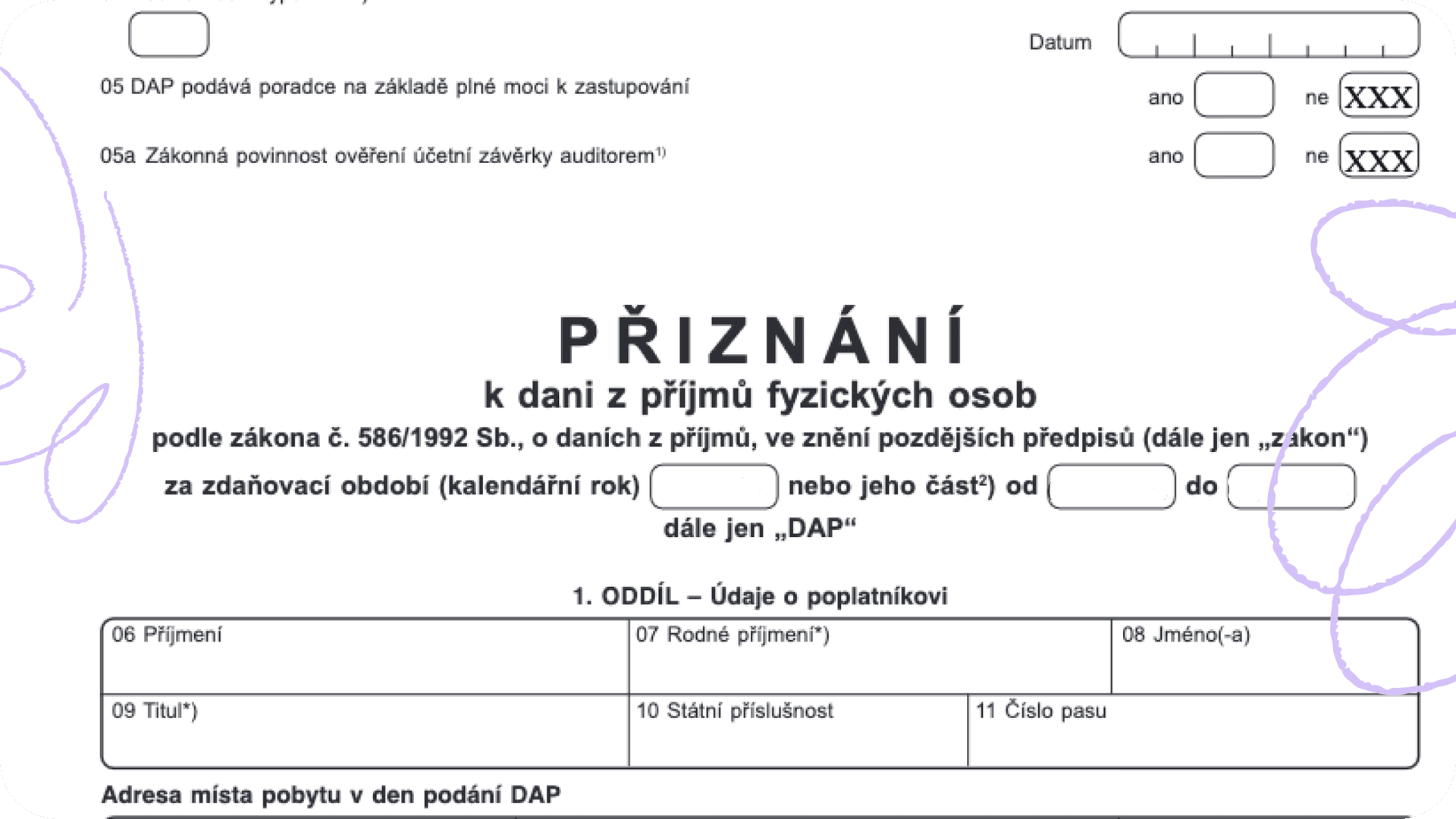
How are RSU taxed in the Czech Republic?
RSU (Restricted Stock Units) are taxable in the Czech Republic. The exact taxation depends mainly on:
when the shares vested,
whether the employer applied deferred taxation,
and when the shares were sold.
The Czech rules changed significantly between 2024 and 2026. The biggest change was the gradual introduction of the:
“No tax before cash” principle
Under this approach, employees should ideally pay tax only after receiving real money from selling shares instead of paying tax immediately during vesting.
What are RSU?
RSU (Restricted Stock Units) are company shares promised to employees after certain conditions are met.
Typical conditions include:
vesting periods,
employment duration,
or performance targets.
Unlike stock options, employees usually do not purchase the shares themselves. The shares are generally transferred after vesting conditions are completed.
RSU are commonly used by:
startups,
technology companies,
multinational corporations,
foreign parent companies.
Main RSU Taxation Changes in the Czech Republic
Period | Main Rule |
|---|---|
Before 31.12.2023 | Immediate taxation during vesting |
1.1.2024 – 31.3.2025 | Qualified ESOP regime |
Source: Finanční správa ČR. Reviewed by Pexpats tax advisors.
How were RSU taxed before 2024?
Until the end of 2023:
RSU were usually taxed immediately during acquisition or vesting,
the benefit was treated similarly to salary income,
and social and health insurance contributions often applied.
This created problems because employees sometimes paid Czech tax before receiving any real money from the shares.
What changed from January 2024?
From 1 January 2024, the Czech Republic changed how many employee stock plans were taxed.
Instead of paying tax immediately during vesting, employees could often postpone taxation until a later event, such as selling the shares.
When could RSU become taxable?
Trigger Event | Taxation Trigger |
|---|---|
Sale of shares | yes |
Leaving employer | yes |
Transfer of shares | yes |
Loss of Czech tax residency | yes |
Employer liquidation | yes |
10-year limit reached | yes |
These changes were introduced into the Czech Income Tax Act (§ 6 ZDP) from January 2024.
What changed again from April 2025?
From 1 April 2025, deferred taxation stopped applying automatically.
If an employer wanted to continue using deferred taxation, the employer needed to notify the Czech tax office (Finanční úřad).
Important 2025 Rule
Situation | Result |
|---|---|
Employer submitted notification | Taxation postponed |
Employer did not submit notification | RSU could become taxable immediately |
The notification generally had to be submitted by the 20th day of the following month after the employee acquired the shares.
This became one of the most confusing Czech tax topics in 2025 because the rules changed multiple times.
What Actually Needed To Be Done If Your RSU Vested In 2025?
Employees often did not know:
whether RSU were taxable,
whether taxation was postponed,
whether the employer submitted the required notification,
or whether they needed to report the income themselves in the Czech tax return

If RSU vested between January 2024 and March 2025
During this period:
postponed taxation generally applied automatically,
employees usually did not pay Czech tax immediately during vesting,
and taxation could be postponed until a future taxable event occurred.
However, after the April 2025 amendment, employers additionally needed to notify the Finanční úřad if they wanted deferred taxation to continue.
If the notification was not submitted correctly or on time, the RSU could become taxable retroactively in 2025.
If RSU vested from April 2025
From April 2025:
immediate taxation became the default approach again,
unless the employer officially applied deferred taxation.
This became especially important for employees receiving RSU from:
US parent companies,
foreign startup groups,
or multinational stock plans.
In many cases, Czech payroll withholding did not happen automatically, meaning employees could still have Czech reporting obligations.
Simple 2025 RSU Logic
Situation | Typical Result |
|---|---|
Employer notified the tax office | Taxation postponed |
Employer did not submit notification | RSU could become taxable immediately |
Shares later sold | Additional taxation may arise |
Foreign parent-company RSU | Employees often needed to report the income manually |
Why So Many Employees Were Confused In 2025
The confusion mainly came from:
multiple legislative changes,
evolving payroll guidance,
international stock plans,
and unfamiliar Czech notification requirements.
As a result, many employees only discovered possible Czech tax obligations later during:
annual tax return preparation,
payroll reviews,
or communication with the Finanční úřad.
Planned 2026 ESOP Changes
The Czech Republic approved another major ESOP reform expected from 2026.
The proposal mainly targets:
startups,
innovative companies,
and smaller technology businesses.
The reform continues the “no tax before cash” principle and introduces additional tax advantages for qualifying employee stock plans.
Main Planned 2026 Advantages
Expected Change | Expected Result |
|---|---|
Taxation after share sale | Better cash-flow for employees |
Social insurance exemption | Lower total taxation |
Health insurance exemption | Lower payroll burden |
Startup-focused regime | Better employee motivation |
Which Companies May Qualify For The 2026 Regime?
According to the currently discussed framework, qualifying companies may need to meet conditions such as:
Qualification Conditions
Requirement | Current Proposal |
|---|---|
Company turnover | Up to 2.5 billion CZK |
Employee salary | At least 1.2× minimum wage |
Employment duration | Minimum 12 months |
Vesting delay | At least 3 years |
Some sectors may be excluded completely, including:
banks,
insurance companies,
investment funds,
tax advisory firms,
and law firms.
Because the legislation is still evolving, some conditions may still change further.
Old Rules vs New Rules
Area | Old Rules | New Rules |
|---|---|---|
RSU vesting | Immediate taxation | Postponed taxation |
Social/health insurance | Usually applied | Exemption |
Employee cash-flow | Tax before sale | No tax before cash |
Startup attractiveness | Lower | Higher |
Can RSU Become Tax Exempt In The Czech Republic? Under standard Czech capital gains rules, some exemptions may still apply depending on how long the shares were held and the total sale amount.
Possible Capital Gains Exemptions
Exemption Type | Condition |
|---|---|
Time test | Shares held longer than 3 years |
Annual sales limit | Total sales below 100 000 CZK |
Source: Finanční správa ČR. Reviewed by Pexpats tax advisors.
RSU from foreign employers
This is one of the most common situations for foreigners living in the Czech Republic.
Many employees receive RSU from:
US parent companies,
foreign startup groups,
or multinational stock plans.
In these situations:
Czech payroll withholding may not happen automatically,
The Czech employer may not administer the stock plan,
and the employee may need to report the income manually in the Czech tax return.
Several Czech tax advisory sources specifically warn that employee shares granted by foreign group companies can require different Czech reporting treatment.
Common RSU Tax Mistakes
Mistake | Risk |
|---|---|
Not reporting foreign RSU | Czech Tax Office penalties |
Ignoring employer notification rules | Immediate taxation |
Assuming only US taxation applies | Incorrect Czech Tax reporting |
Using incorrect acquisition value | Double taxation risk |
Ignoring residency changes | Unexpected tax obligations |
FAQ — RSU Taxation Czech Republic
Are RSU taxable in the Czech Republic?
Yes. RSU are generally taxable either as employment income or during the sale of shares depending on the applicable regime.
Are RSU taxed during vesting?
Sometimes. It depends on the year, employer reporting, and whether deferred taxation applies.
What does “no tax before cash” mean?
It means employees should ideally pay tax only after receiving real money from selling shares.
Do RSU trigger Czech social and health insurance?
Under older rules usually yes. Under the planned qualified ESOP regime, qualifying plans may become exempt.
Are foreign RSU included in Czech tax returns?
Usually yes if the employee is considered a Czech tax resident.
Which Czech authority supervises RSU taxation?
Finanční správa ČR and the relevant Finanční úřad supervise Czech income tax reporting.
Who reviews and updates this information?
Pexpats — Czech Tax and Accounting Agency focused on foreigners and international tax situations in the Czech Republic.
Need Help With RSU Tax Reporting In The Czech Republic?
RSU taxation becomes more complicated when it involves:
foreign employers,
US brokerage platforms,
multinational stock plans,
or double taxation treaty situations.
Pexpats helps foreigners in the Czech Republic with:
Czech tax returns,
RSU taxation,
foreign income reporting,
employee stock declarations,
and communication with Czech authorities.
Pexpats operates as a registered Czech tax and accounting agency. Company registration and public business information can be verified through official Czech government registers.