
Starting a Czech trade license does not mean that you immediately start paying monthly income tax.
Under the standard tax system, you earn money during the year, keep records of your business income and calculate your income tax after the tax year ends.
KEY FACT
Having an active trade license does not create income tax by itself. Your final tax depends on your taxable income and your overall tax situation.
Social and health insurance work differently and have their own payment rules.
When Do You First Pay Income Tax?
Under the standard tax system, freelancers usually settle income tax through the annual Czech income tax return.
If you start your trade during the year, you report the business income earned from the date you started until the end of that calendar year.
For example, if you start in September, your first tax return includes your business income from September to December.
You do not start paying monthly income tax just because your trade becomes active.
KEY FACT
Your first income tax payment usually comes after the tax year in which you started your business.
The exact filing dates are explained on the Tax Deadlines page.
What If You Have No Income From Your Trade?
If you earn nothing from your trade during the year, there is no trade income to tax.
This does not automatically mean that you have no other obligations. Social insurance, health insurance, employment income, foreign income or other parts of your tax situation can still matter.
Is Income Tax Calculated From Everything You Invoice?
No. Your income tax is not calculated simply by multiplying the total amount you invoice by a tax rate.
Business expenses reduce the amount used to calculate your tax. Depending on your activity, you can use actual expenses or a percentage expense allowance.
For ordinary trade business income, the percentage expense allowance is 60%. This means 60% of qualifying income can be treated as expenses without proving each expense with receipts. The maximum expense amount under the 60% allowance is 1,200,000 CZK. Craft trades use a different 80% category.
IMPORTANT NOTE
If you use the 60/40 method, the 60% allowance already includes your business expenses. You cannot deduct additional business expenses separately.
Once you use the percentage-expense method for a tax year, you cannot later go back and replace it with your actual expenses for the same tax year.
The percentage-expense method cannot be changed retroactively for the same tax year.
LEGAL REFERENCE
Act No. 586/1992 Sb., Income Tax Act, § 7(7)–(8).
Section 7(7) states that the percentage-expense method cannot be changed retroactively. Section 7(8) confirms that the percentage allowance includes all expenses connected with earning that income.
Watch: How the 60/40 Tax Method Works
This video explains how the 60/40 method works for Czech freelancers and when the expense allowance can be used. What Income Tax Rate Do You Pay?
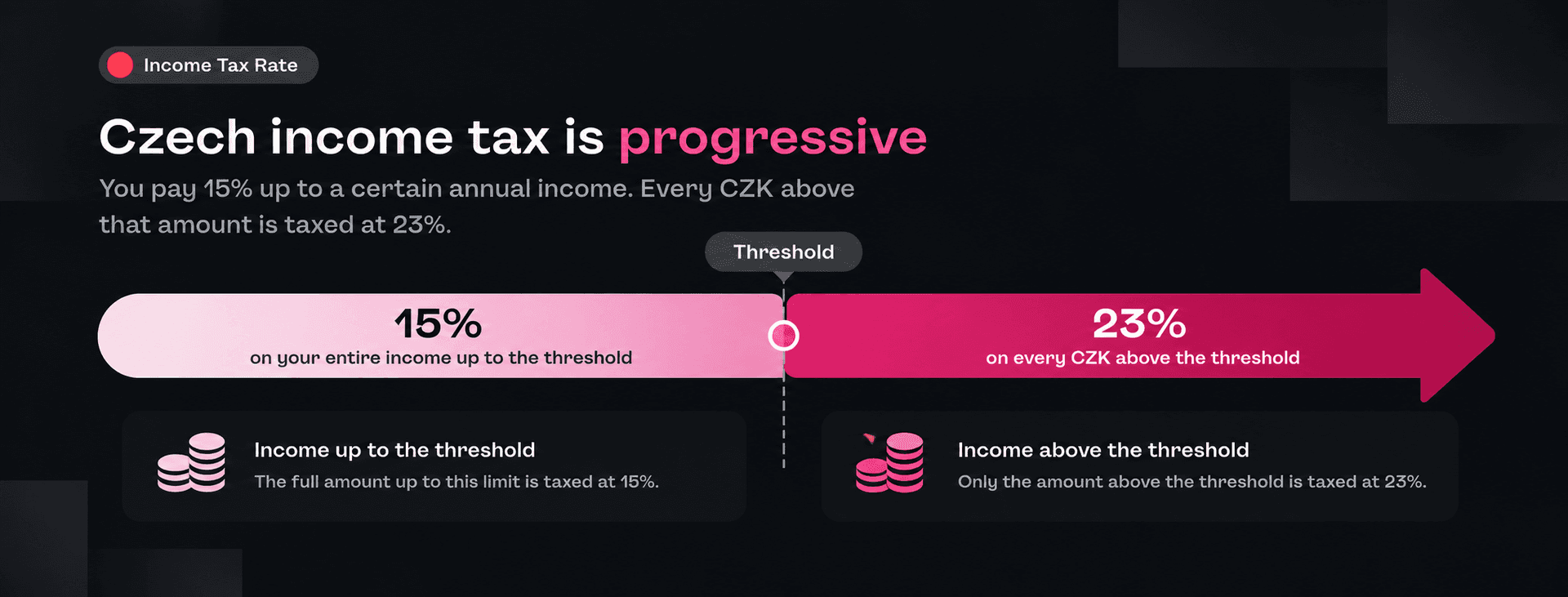
Czech personal income tax uses two rates: 15% and 23%.
The higher 23% rate applies only to the part of the tax base above the applicable annual threshold. Passing the threshold does not make your entire tax base subject to 23%.
You can find the current threshold and calculation on the Income Tax Rates page.
KEY FACT
Crossing the 23% threshold does not mean that all of your income is taxed at 23%.
Tax Discounts Can Reduce Your Final Tax
After income tax is calculated, applicable tax discounts can reduce the final amount you need to pay.
The Czech system includes the basic taxpayer discount and other tax discounts or benefits if you meet their conditions.
This is another reason why simply multiplying your invoices by 15% does not tell you your final tax.
Calculate Your Czech Freelancer Tax
Use the Pexpats tax calculator to estimate the income tax, social insurance and health insurance connected with your freelance income.
Czech Freelancer Tax Calculator
Calculate your estimated Czech income tax, social insurance and health insurance based on your yearly freelance income.
PRACTICAL PEXPATS NOTE
The calculator gives you an estimate. Your final tax can be different depending on your yearly tax situation.
Do You Need to Register for Income Tax After Starting a Trade?
Since 01.01.2024, self-employed individuals (OSVČ) no longer have the general obligation to register for Czech personal income tax just because they start a business.
This change removed the registration obligation, but it did not remove the obligation to file an income tax return and pay income tax when required.
For foreigners, however, tax identification can be particularly important. Not every foreign entrepreneur has a Czech birth number (rodné číslo).
This can include EU citizens and other foreigners who start a Czech business without having a Czech birth number.
When an individual does not have a Czech birth number, the Czech tax office assigns its own identifier called a VČP (vlastní číslo plátce).
The Financial Administration specifically confirms that foreign individuals without a Czech birth number receive a VČP from the tax authority and use this number, for example, as the variable symbol when paying Czech personal income tax.
KEY FACT
Not every foreign freelancer has a Czech rodné číslo. If you do not have one, the tax office can assign you a VČP as your identifier for the Czech tax administration.
Even though personal income-tax registration is no longer generally mandatory for a new OSVČ, Pexpats recommends resolving your Czech tax identification as part of the initial business setup.
This is especially useful for foreigners. Having your tax identification resolved gives you a clear identifier for dealing with the Czech tax system instead of discovering later, when you need to file or pay tax, that you do not have a Czech birth number and need the tax office to assign a VČP.
Tax identification can also become important as your business develops, for example when another Czech tax registration becomes necessary. Banks, brokers, investment platforms and other financial services may also ask for your tax identification number.
For these reasons, the fact that income-tax registration is no longer generally mandatory does not mean that tax identification is irrelevant for a foreign freelancer.
LEGAL REFERENCE
Act No. 280/2009 Sb., Tax Code, § 130(1)–(4)
Section 130 explains how Czech tax identification works. A registered taxpayer is assigned a DIČ. For an individual, the standard identifier is normally the Czech birth number (rodné číslo).
If a person does not have this identifier, the tax office assigns its own identifier (VČP).
What About DIČ?
IČO and DIČ are different numbers. IČO identifies your Czech business, while DIČ is a Czech tax identification number.
Getting an IČO does not automatically give you a DIČ. You can read more about DIČ and when you may need one on the TIN / DIČ page.
What If You Also Have a Job or Other Income?
If you have several sources of income, such as Czech employment, self-employed income or foreign income, the income that must be included in your Czech tax return is considered together when calculating your annual personal income tax.
Your tax is calculated from your annual tax base. The applicable tax discounts and tax bonuses are then taken into account.
If your Czech employer already deducted income-tax advances from your salary during the year, these payments are not lost. The tax advances already paid through your employment are deducted from your final annual income-tax liability.
This means you are not simply taxed again on income for which your employer has already been deducting Czech income-tax advances.
What If You Also Have a Job or Other Income?
If you have several sources of income, such as Czech employment, self-employed income or foreign income, the income that must be reported in your Czech tax return is included in the same annual income-tax calculation.
Your tax is calculated from your annual tax base. Any tax discounts and bonuses you qualify for are then applied.
If your Czech employer already deducted income-tax advances from your salary during the year, these payments are not lost. The tax advances already paid through your employment are deducted from your final annual income-tax liability.
This means you are not simply taxed again on income for which your employer has already been deducting Czech income-tax advances.
EXAMPLE:
You have employment income and also earn income from your Czech trade during the same year.
Your employment and business income that belongs in the return is included in the annual calculation. Your business expenses reduce the taxable amount from your trade. Your annual income tax is then calculated, any tax discounts and bonuses you qualify for are applied, and the income-tax advances already deducted from your salary are credited against the result.
If the tax already paid is lower than your final tax, you pay the difference. If you paid more than your final tax, you can have a tax overpayment.
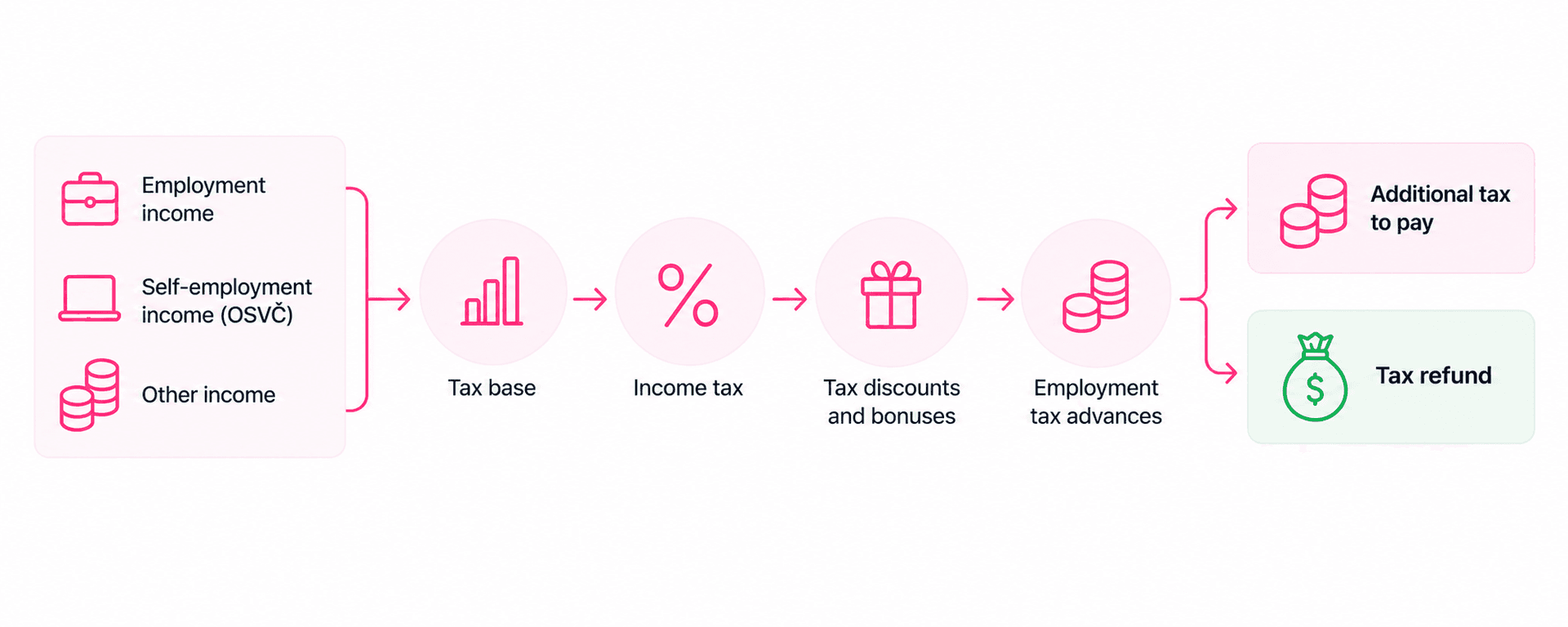
Income-tax advances deducted from your Czech salary during the year are credited against your final annual income-tax liability. They are not a separate additional tax on top of your annual calculation.
IMPORTANT NOTE
Foreign income may follow different rules under a double-tax treaty. How it is taxed depends on the country and the type of income.
What Should You Keep From the First Day?
Keep your business records from the day you start. You will need them for your annual tax return, and the tax office can also ask you to prove the income and expenses reported in your tax return.
Keep:
issued invoices;
records of business payments received;
records of your business income;
foreign-income and foreign-currency records when relevant;
expense documents if you use actual expenses; and
other documents that support the income or expenses reported in your tax return.
KEY FACT
Czech freelancers using tax records must keep them for every tax year for which the tax office can still assess the tax. The standard tax-assessment period is three years, but in some situations it can be extended or restarted.
Do not wait until tax season to reconstruct your business income. Keep your invoices, payment records and other relevant documents as you go during the year.
You may need them later if the tax office asks you to support the figures reported in your tax return.
If you create invoices with the Pexpats Invoice Generator, your invoices are stored in your account for an unlimited period at no charge.
You can return to an old invoice and download it whenever you need it, including years later.
Create & Store Invoices for Free
LEGAL REFERENCE
Act No. 586/1992 Sb., Income Tax Act, § 7b(5)
Freelancers using tax records must keep those records for all tax years for which the period for assessing the tax has not yet expired.
View the law: Income Tax Act, § 7b
Act No. 280/2009 Sb., Tax Code, § 148
The standard period during which the tax office can assess tax is three years. The period can be extended or restarted in situations defined by law, so three years should not be treated as an absolute document-destruction deadline.
Your First Year in Practice
A typical first year under the standard tax system looks like this:
1. You start your trade and begin invoicing clients.
2. You keep records of your business income and the documents needed for your chosen expense method.
3. You do not start paying income-tax advances just because the trade was registered.
4. After the calendar year ends, you prepare your first Czech income tax return and calculate the tax for that year.
5. Based on the tax calculated in that return, you may then have to start paying income-tax advances.
PRACTICAL PEXPATS NOTE
One of the most common questions we receive after registering a trade is: “I received instructions to pay social and health insurance every month, but how much income tax should I pay monthly?”
The confusion often comes from using the word “tax” for all three payments. Under the standard tax system, income tax works differently.
Social and health insurance can involve monthly deposits, while income tax is calculated from your annual tax situation after the tax year ends.
You therefore do not normally calculate separate income tax for September, October or another individual month.
Your income can change from month to month or even be zero in some months. The yearly amounts are what matter for the final income-tax calculation.
Example: A freelancer starts in September and earns 100,000 CZK in September, nothing in October and another 300,000 CZK before the end of December.
You do not calculate four separate monthly income taxes. The business income for the tax year is calculated together, using the chosen expense method and any other income or tax circumstances that apply for that year.
What Happens After Your First Tax Return?
Your first tax return works out the income tax for the year in which you started your trade.
After your first tax return, you may also have to start paying income-tax advances. The amount and frequency are based on your last known tax liability.
Under the standard rules:
If your last known tax liability is 30,000 CZK or less, you do not pay income-tax advances.
If it is more than 30,000 CZK but no more than 150,000 CZK, you normally pay two advances, each equal to 40% of your last known tax liability.
If it is more than 150,000 CZK, you normally pay four advances, each equal to 25% of your last known tax liability.
If you also have Czech employment income, the rules can be different. If employment income subject to employer tax advances makes up at least 50% of your total tax base, you do not pay these income-tax advances.
If it makes up at least 15% but less than 50%, the advances are reduced by half.
Income-tax advances are not an additional tax. Advances paid during the year are credited against your actual income tax when the tax for that year is settled.
You can find the full rules, employment exceptions and payment dates on the Income Tax Advance Payments page.
LEGAL REFERENCE
Act No. 586/1992 Sb., Income Tax Act, § 38a(1)–(5)
Section 38a explains when income-tax advances start, how much you pay and how often. No advances are required when the last known tax liability is 30,000 CZK or less. Above 30,000 CZK and up to 150,000 CZK, two 40% advances apply. Above 150,000 CZK, four 25% advances apply. The section also contains special rules when part of your tax base comes from employment.
Frequently Asked Questions
No. Under the standard tax system, getting a Czech trade license does not by itself create an immediate income-tax payment. You earn business income during the year and normally settle your income tax through your annual Czech income tax return after the tax year ends.
Not. Business expenses reduce the amount used to calculate your taxable business income. Depending on your activity, you can use actual expenses or a percentage expense allowance, such as the 60% allowance commonly used for ordinary trade business income.
Both rates are used. The 15% rate applies up to the annual threshold, while the 23% rate applies only to the part of your tax base above that threshold. Crossing the threshold does not mean that your entire tax base is taxed at 23%.
Your employment and self-employed income can both be included in your annual Czech tax calculation. Income-tax advances already deducted from your Czech salary are credited against your final annual income tax.
Depending on your freelance income and circumstances, you may need to file your own Czech tax return instead of relying on your employer’s annual tax calculation.
No. Having foreign clients does not by itself make your freelance income tax-free in the Czech Republic. Where the income is taxable can depend on your tax residency, where you perform the work, the type and source of income, and any applicable double-tax treaty.
It depends on your last known tax liability. Under the standard rules, you do not pay income-tax advances if it is 30,000 CZK or less. Above 30,000 CZK, advance payments can start, with their amount and frequency depending on your last known tax liability. Employment income can also reduce or remove the advance-payment obligation.
Official Sources
Financial Administration of the Czech Republic Official information about starting a business and the removal of the general personal income tax registration obligation for self-employed people from 01.01.2024.
Starting a Business — Financial Administration
Financial Administration of the Czech Republic Official overview of the Czech tax system, including the 15% and 23% personal income tax rates and tax discounts.
Description of the Czech Tax System — Financial Administration
Financial Administration of the Czech Republic Official Czech tax calendar for current tax filing and payment dates.